
How New Car Technology Is Changing the Way We Drive
Advancements in new car technology are reshaping not just the vehicles we drive but also the very nature of the driving experience. From artificial intelligence to electrification, these innovations are enhancing safety, fuel efficiency, and connectivity in ways that seemed futuristic just a decade ago. Early adopters and everyday drivers alike are now experiencing smarter, safer, and more interactive journeys behind the wheel. Learn more about the latest vehicles driving these changes.
The integration of advanced driver assistance systems, seamless connectivity, and innovative powertrains is leading to a paradigm shift across the automotive industry. Automakers are incorporating AI-driven manufacturing and design improvements, while electric vehicles and enhanced autonomy are making transport more sustainable and enjoyable. As more consumers demand these features, manufacturers are pushing boundaries with every new model.
Every year, more drivers experience the benefits of real-time connectivity and safety features that learn and adapt to ensure seamless and secure travel. Whether it is the convenience of connected services or the efficiency improvements driven by electrified powertrains, the latest technologies promise both comfort and peace of mind on the road.
Automotive experts predict that these innovations will only accelerate over the next decade, transforming mobility for everyone. The result is a safer, smarter, and more engaging driving experience that continues to evolve rapidly.
AI and Automation in Vehicle Design
Artificial intelligence is transforming how vehicles are designed and built. Automakers such as Mercedes-Benz and BMW are leveraging AI across their manufacturing plants for predictive maintenance, production optimization, and even in-cabin technology development. With machine learning and automated workflows, engineers can identify and resolve potential issues before they impact reliability or customer experience. Automation is also streamlining production lines, reducing manual errors, and ensuring that vehicles meet strict quality standards across global markets.
AI does not just influence manufacturing. It also enables smarter in-car features, including intelligent voice assistants and adaptive user interfaces that personalize the vehicle environment for each driver and passenger.
Advanced Driver Assistance Systems (ADAS)
Vehicles equipped with ADAS provide a new level of driver support and safety. Features such as automatic emergency braking, lane-keeping assist, and blind-spot monitoring are now standard or widely available on most new models. These systems use cameras, radar, and ultrasonic sensors to continuously monitor the vehicle’s surroundings and intervene when necessary. According to the National Highway Traffic Safety Administration, integrating ADAS technologies reduces the risk of severe crashes and supports safer roads for all users.
As regulations evolve, automakers are expanding their ADAS offerings. For example, upcoming safety assessment protocols will include more ADAS functions as standard crash test criteria, pushing the industry toward even safer vehicle designs.
Electric Vehicle Advancements
Electric vehicles are fundamentally changing driving, both through reduced emissions and performance gains. Battery technology is advancing rapidly, enabling some EVs to travel over 400 miles on a single charge. Innovations like solid-state batteries promise even greater energy density and faster charging in the near future. Additionally, vehicle-to-grid (V2G) systems allow EVs to supply surplus power back into homes or the electrical grid, supporting a more resilient and sustainable energy ecosystem. Consumer adoption is increasing as EVs become more practical and affordable, supported by growing charging infrastructure and government incentives.
Connected Cars and In-Cabin Experiences
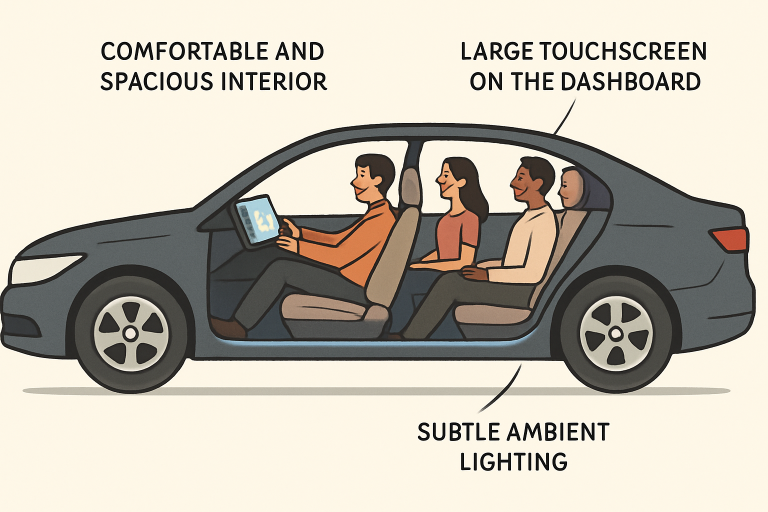
Connected car technology is fundamentally altering the in-cabin experience. Modern vehicles now feature integrated voice assistants, real-time navigation, and immersive multimedia systems. At CES 2025, manufacturers showcased advanced solutions, including Hyundai Mobis’s holographic windshield displays and BMW’s panoramic iDrive interface. These innovations provide drivers with relevant information that is easy to access without distraction, and they also enhance passenger comfort and entertainment. In addition, connected car services can help monitor vehicle health and provide proactive maintenance updates directly to a driver’s smartphone.
Steer-by-Wire Technology
Steer-by-wire replaces conventional mechanical steering linkages with electronic controls. This allows fine-tuning of steering responses, reduces vibration, and can enable new forms of vehicle architecture. Peugeot’s “Polygon” concept and its “Hypersquare” steer-by-wire system illustrate the industry shift toward customizable steering and adaptable vehicle platforms. This technology lays the foundation for even more advanced autonomous-driving features, as electronic steering can respond quickly to both driver inputs and automated driving commands.
Adaptive Cruise Control
Adaptive cruise control uses radar and cameras to detect vehicles ahead and automatically adjusts speed to maintain a safe distance. This makes long drives less tiring and reduces the risk of tailgating-related collisions. By minimizing abrupt speed changes and helping the vehicle adapt to traffic patterns, adaptive cruise control enhances comfort while supporting efficient traffic flow. It is also a critical building block for semi-autonomous and fully autonomous driving technologies.
Lane Centering Systems
Lane centering technology provides steering input to help keep a vehicle precisely within lane boundaries. When paired with adaptive cruise control, it substantially reduces the frequency of steering corrections required by drivers during highway commuting. These systems rely on a network of sensors, cameras, and advanced algorithms to provide smooth and confident steering support, contributing to both convenience and safety as autonomous driving moves closer to becoming a mainstream reality.
Conclusion
The landscape of car technology is transforming quickly, making vehicles safer, smarter, and more efficient. From the factories where cars are designed to the highways where they are driven, technology is enhancing every aspect of mobility. With ongoing investments in automation, electrification, and connectivity, drivers and passengers can expect a future in which transportation is not only more sustainable and secure but also more exciting and accessible than ever.